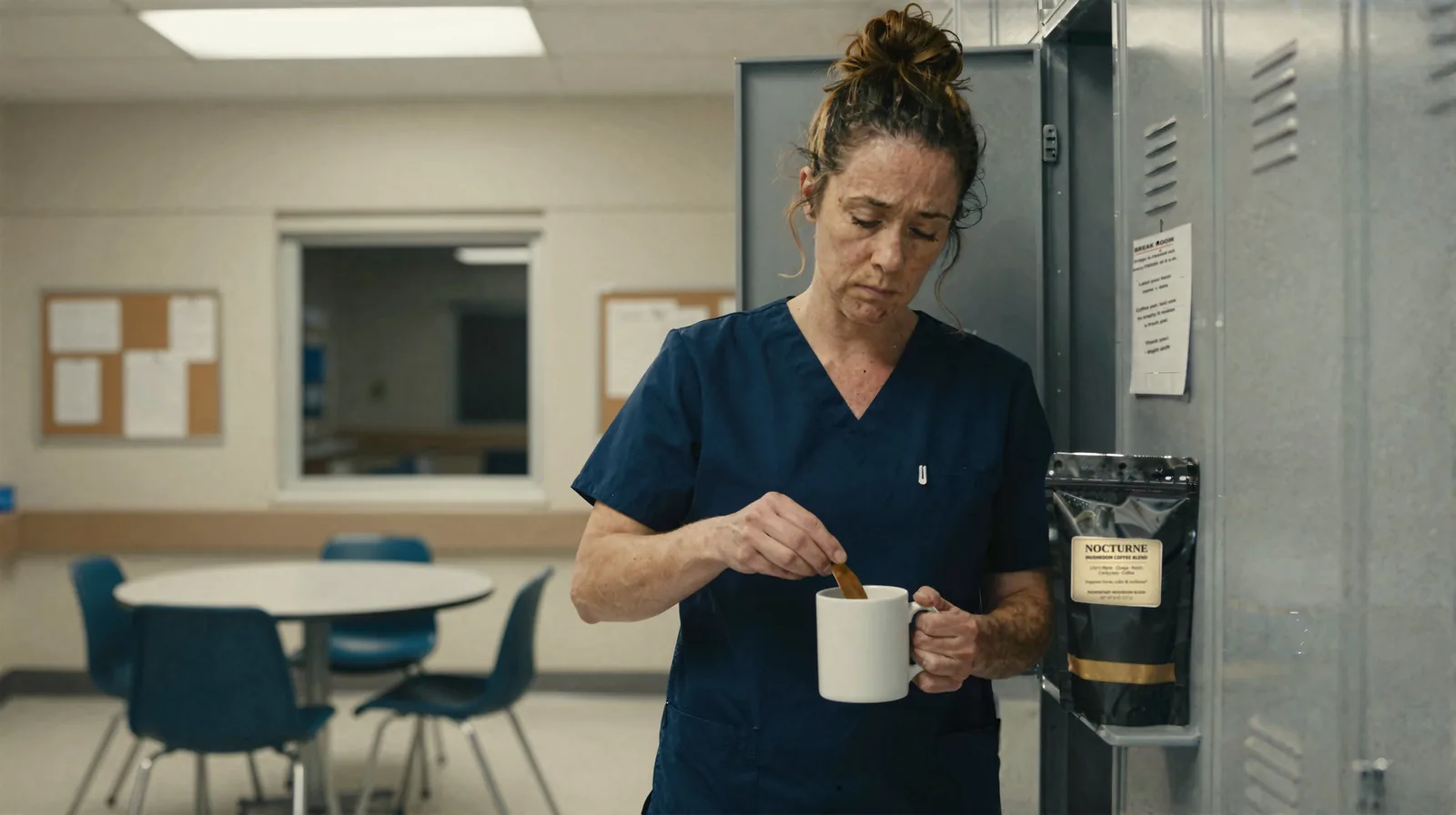
At 4:10 a.m. the emergency department went quiet in the way that makes night nurses nervous.
Dana Whitfield used the lull the way she had for three months. She walked to the break room, opened her locker and took out a matte black bag with a gold label. She measured one level scoop into a paper cup, poured hot water from the dented pot, and stirred it the way you stir something you have paid $48 for.
Lion's mane. Chaga. Reishi. Cordyceps. Coffee.
She had first seen it in a video at 2 a.m. on a night off: a woman in a bright kitchen holding the same black bag, saying the blend had killed her cravings and made the weight fall off. Dana ordered it before the video ended.
Three months later the weight had not fallen anywhere. The cravings were the same as they had always been at 4 a.m. And the bag was nearly empty.
At 4:14 the charge nurse walked in, looked at the bag and asked a question Dana could not answer.
4:14 a.m."What's actually in that?"
Pam has been a nurse for thirty years and trusts nothing that comes in a matte black bag.
Dana is 39, eleven years on nights at a hospital in Raleigh, North Carolina. She reads medication labels for a living. She turned the bag over.
The label listed a proprietary mushroom blend with no amount for any single mushroom. It did not say how much caffeine was in a scoop. It said the product supported focus, calm and wellness.
Down the hall a monitor alarmed twice and went quiet. Somebody laughed at the nurses' station. Dana barely heard either. She read the label again, slower, holding the bag under the fluorescent light the way she holds an IV bag to check a line, looking for one particular word.
The word weight was not on the bag anywhere.
"So you're paying for coffee," Pam said, and went back out to the floor.
Every promise Dana had bought came from the woman in the video, not from the company that made the product. The label had never claimed what she thought she was paying for.
Dana did what nurses do with a claim they do not trust. She went looking for the evidence.
7:40 a.m.The evidence, read in a parking deck
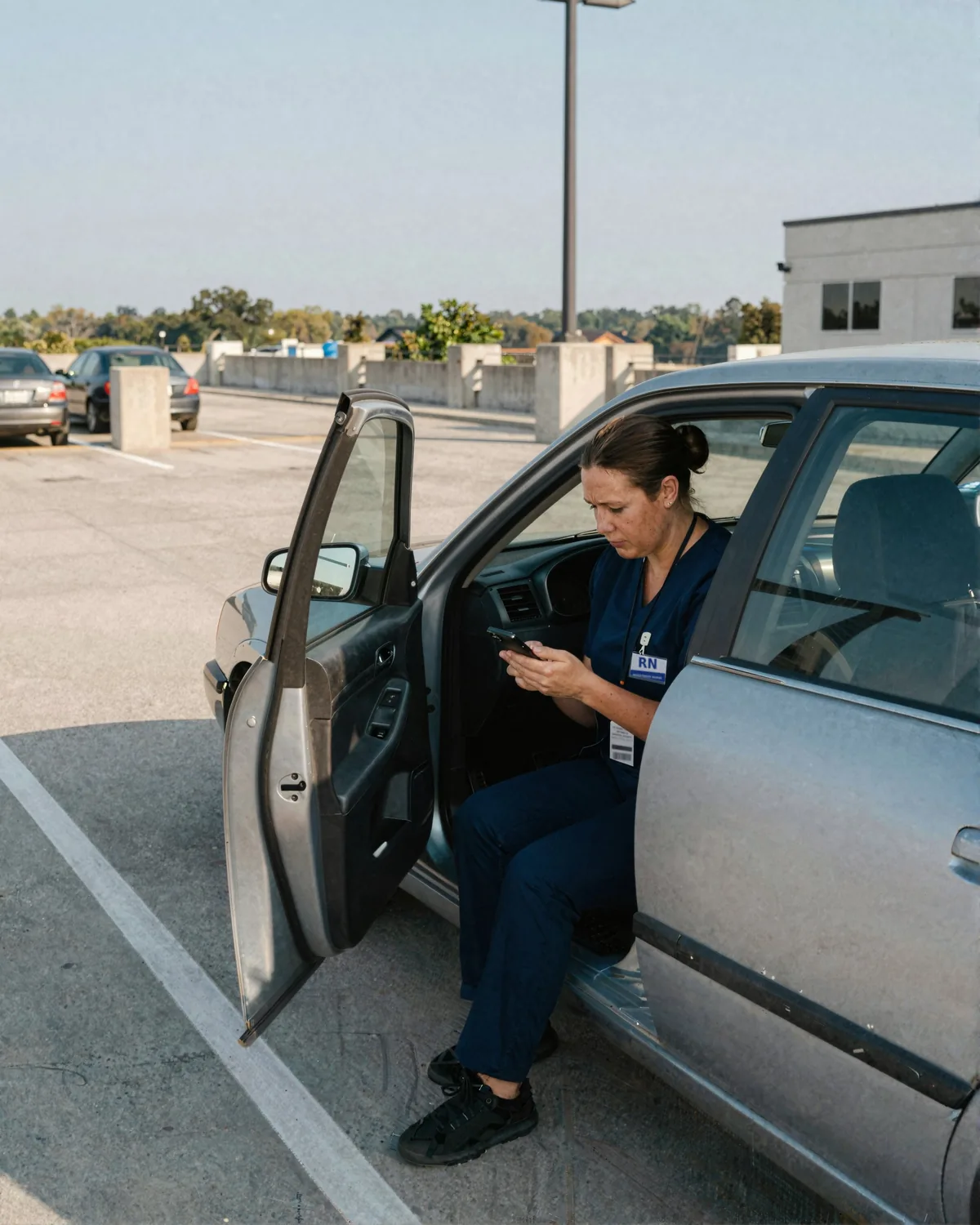
She read it on her phone in the hospital parking deck after her shift, still in her scrubs, the engine off, the sun coming up over the concrete.
Mushroom coffee is regular coffee, or a coffee substitute, blended with powdered extracts of mushrooms such as lion's mane, chaga, reishi, cordyceps or turkey tail. Most of the research on these mushrooms has been done in cells or animals. There are no solid human trials showing that a mushroom coffee causes weight loss.
Cleveland Clinic puts it plainly: there is no evidence that mushroom coffee helps with weight loss, and supplement-grade mushrooms may carry risks, such as heavy metals, when they are poorly sourced.
Sources: Cleveland Clinic; FDA, Spilling the Beans; Google Keyword Planner, US (260 in Nov. 2025, 1,300 in Oct. 2026).
Dana sat in the car and read it twice. Then she asked the obvious next question. If the mushrooms were not doing anything to her appetite, was anything in that cup doing something?
The answer was the part of the drink that was not a mushroom at all.
The coffee.
The studiesWhat coffee really does to appetite
Coffee is one of the most studied drinks in the world, and the appetite research is more modest than the internet suggests.
| Study | What was tested | What it found |
|---|---|---|
| Review, Int J Food Sci Nutr, 2017 | Coffee and caffeine on appetite and food intake | Caffeine 0.5 to 4 hours before a meal may reduce how much is eaten; coffee 3 to 4.5 hours before had little effect |
| Trial, J Acad Nutr Diet, 2018 | Caffeine at breakfast in 50 adults | Weak, short-lived effects; the authors did not support caffeine as an effective appetite suppressant |
| Trial, Obesity, 2013 | Different amounts of coffee | A higher coffee dose lowered intake at the next meal in overweight and obese participants only |
| Trial, J Am Coll Nutr, 2012 | Decaf coffee vs. caffeine in water | Decaf lowered hunger and raised the fullness hormone PYY for a while; caffeine in water did not |
Sources: PubMed 28446037, 30033159, 23671022, 23204152.
Results varied a lot between people; hormone and hunger-rating results were mixed.
- 0.5 to 4 hours beforeCaffeine may reduce how much is eaten at that meal
- 3 to 4.5 hours beforeCoffee had little effect on intake
- Every day, for weeksThe effect fades as people get used to caffeine
Source: Schubert et al., Caffeine, coffee, and appetite control: a review, Int J Food Sci Nutr 2017 (PubMed 28446037).
Put together: coffee can take a small edge off appetite for a few hours, partly through caffeine and possibly through other compounds in the bean. It is a helper, not a fat burner. The bigger lever is what goes into the cup and what you eat with it.
Then Dana did the math on her own night, and found the thing that had been in her locker all along.
8:05 a.m.The math on a twelve-hour night
The FDA says about 400 mg of caffeine a day is an amount not generally associated with negative effects in healthy adults. A 12-ounce cup of regular brewed coffee holds roughly 113 to 247 mg. She counted on her fingers in the driver's seat.
Two cups of hospital coffee. One scoop of the mushroom blend, caffeine unknown. On bad nights, an energy drink from the vending machine at 2 a.m. And then she was supposed to drive home and sleep.
The FDA's 400 mg reference sits inside the two-cup range.
Source: FDA, Spilling the Beans: How Much Caffeine Is Too Much? (12-oz brewed coffee about 113 to 247 mg; about 400 mg a day for healthy adults).
The mushroom bag had been the least important thing in her locker. What mattered was the caffeine she could not count, the sugar she stirred into the second cup, and the vending machine at 2 a.m.
She did not need a new drink. She needed one she could read.
Last SundayWhat Dana drinks at 4:10 now
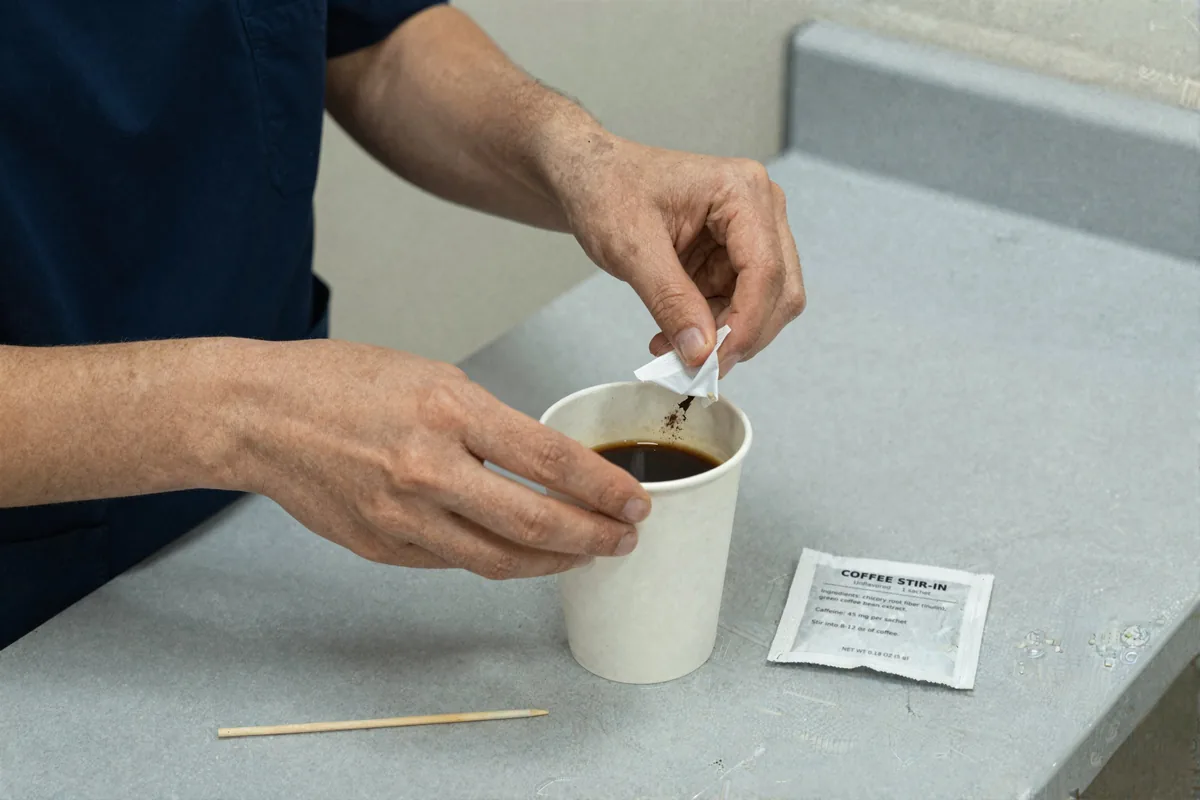
The black bag went in the trash in the break room. Dana went back to the plain hospital coffee she had been drinking for eleven years, black, the way Pam drinks it, and stopped buying the energy drink.
What she added was small: a paper sachet with a printed label, flavorless, that stirs into the coffee she already drinks. She chose it for three reasons she could check herself. The label lists every ingredient. The coffee still tastes like coffee. And it prints how much caffeine is in it, so she can count it with the rest of her night.
At 4:10 last Sunday the department went quiet again. Dana walked to the break room, poured a cup from the same dented pot, tore the sachet and stirred.
Pam came in, looked at the cup and the paper sachet with its printed label, and nodded once.
"Now that," she said, "I can read."
Does mushroom coffee help you lose weight?
Short answer: there is no good evidence that it does. The appetite effect people describe most likely comes from the coffee and its caffeine, and from the other changes that tend to come with a new morning ritual: fewer pastries, less sugar in the cup, more attention to what you eat. Those can make a real difference, and the drink gets the credit. Many mushroom blends also contain less caffeine than regular coffee, and the label often does not say how much.
From 260 a month to 1,300; "best mushroom coffee for weight loss" peaked at 9,900 in February 2026.
Source: Google Keyword Planner, US, English, November 2025 to October 2026, pulled Nov. 28, 2026.
Why mushroom coffee feels like it works
Dana is not the only person who swore the bag was helping in the first few weeks. A new morning ritual usually arrives with other changes: you skip the pastry because you are drinking the expensive cup, you stop putting sugar in it because the label looks healthy, you pay more attention to what you eat because you have decided this is the month things change. Those changes are real, and they can make a difference on their own. The drink simply gets the credit.
That is not nothing, but you do not need a $48 bag to get it. The same habits ride just as well on a plain cup of coffee you already like.
Is mushroom coffee safe?
For most healthy adults an occasional cup is unlikely to cause problems. The concerns Cleveland Clinic raises are about what you cannot see: supplement-grade mushrooms are not tightly regulated, and poorly sourced powders can carry heavy metals. A proprietary blend makes it impossible to know how much of each mushroom you are getting, and a label without a caffeine figure makes it impossible to count your day. If you take medicine, are pregnant or have a health condition, ask your doctor before adding any mushroom extract, and treat any product that will not tell you its doses as a product you cannot judge.
Coffee on Ozempic and other GLP-1 medicines
- The Wegovy prescribing information does not list coffee or caffeine as an interaction.
- GLP-1 medicines commonly cause nausea, reflux and constipation, and some people find coffee makes the first two worse on dose-increase days.
- If you have vomiting or diarrhea, dehydration is the bigger risk; water comes before a second cup.
- No coffee, mushroom blend or coffee add-in is a GLP-1 medicine or a substitute for one.
If you take a GLP-1, our GLP-1 diet guide covers what to eat on it. If you are comparing options, the GLP-1 pill guide lists self-pay prices, and our page on natural GLP-1 supplements explains berberine and the other ingredients sold as GLP-1 boosters.
How to choose a coffee for weight loss
- Know the caffeine. The label should tell you how much is in a serving.
- Watch the add-ins. Flavored syrups, sweetened creamers and whipped toppings can add more calories than a snack.
- Look for fiber if fullness is the goal. Soluble fibers such as psyllium and resistant dextrin add bulk and help you feel full; that is a better-supported route than a mushroom extract.
- Avoid proprietary blends. If a label hides the dose of each ingredient, you cannot judge it.
- Keep the habit you already have. The easiest change is one that rides on the cup you drink every morning.
Mushroom coffee and weight loss: questions people ask
Does mushroom coffee help you lose weight?
There are no good human trials showing that mushroom coffee causes weight loss. Cleveland Clinic says there is no evidence it helps with weight loss, and most of the mushroom research is in animals or cells. Any appetite effect from a mushroom blend most likely comes from the coffee and caffeine in it.
What is the best mushroom coffee for weight loss?
No mushroom coffee is proven for weight loss, so there is no honest "best" for that goal. If you like it, choose one that prints the caffeine per serving and the amount of each mushroom, avoids proprietary blends, and is tested for heavy metals. For appetite, the caffeine, fiber and what you add to the cup matter more than the mushrooms.
Does caffeine curb hunger?
A little, and briefly. A 2017 review found caffeine taken 30 minutes to 4 hours before a meal may reduce how much people eat at that meal, while coffee drunk 3 to 4.5 hours earlier had little effect. A 2018 trial in 50 adults found caffeine's effect on intake was weak and short-lived.
Can coffee help you lose weight?
Black coffee has almost no calories and its caffeine may slightly blunt appetite for a short time, so it can fit a weight loss plan. It does not burn meaningful fat on its own, and sugar, syrups and cream can turn a cup into a dessert. Coffee helps most as a low-calorie habit, not as a fat burner.
Can you drink coffee on Ozempic, Wegovy or another GLP-1?
The Wegovy prescribing information does not list coffee or caffeine as an interaction. Many people drink coffee on GLP-1 medicines; some find it worsens nausea or reflux, and dehydration is a concern if you also have vomiting or diarrhea. Ask your prescriber if you notice a problem.
How much caffeine is too much?
The FDA says about 400 mg a day is an amount not generally associated with negative effects in healthy adults, roughly two to three 12-ounce cups of brewed coffee. Pregnant or breastfeeding women and people on some medicines may need less. Count every source: coffee, tea, energy drinks and supplements.
Is mushroom coffee safe?
For most healthy adults an occasional cup is unlikely to cause problems, but Cleveland Clinic warns that supplement-grade mushrooms are not tightly regulated and can carry risks such as heavy metals if they are poorly sourced. Check with your doctor if you take medicines or have a health condition.
What can I add to coffee for weight loss?
Keep the add-ins low in sugar: a splash of milk, cinnamon, or a low-calorie add-in with a printed label. If feeling full is the goal, soluble fibers such as psyllium and resistant dextrin are a better-supported route than mushroom extracts. Count any caffeine an add-in contains toward your daily total.
Sources and notes
- Mushroom coffee: should you be drinking it?, Cleveland Clinic
- Schubert et al., Caffeine, coffee, and appetite control: a review, Int J Food Sci Nutr, 2017 (PubMed 28446037)
- Panek-Shirley et al., Caffeine transiently affects food intake at breakfast, J Acad Nutr Diet, 2018 (PubMed 30033159)
- Gavrieli et al., Effect of different amounts of coffee on dietary intake and appetite, Obesity, 2013 (PubMed 23671022)
- Greenberg and Geliebter, Coffee, hunger, and peptide YY, J Am Coll Nutr, 2012 (PubMed 23204152)
- Spilling the Beans: How Much Caffeine Is Too Much?, FDA
- Wegovy (semaglutide) prescribing information, revised 10/2025, FDA
- Google Keyword Planner, United States, English: monthly search volume November 2025 to October 2026, pulled November 28, 2026
Search volumes are Google Keyword Planner monthly estimates for the United States, which Google rounds into bands; they show direction and scale, not exact counts.