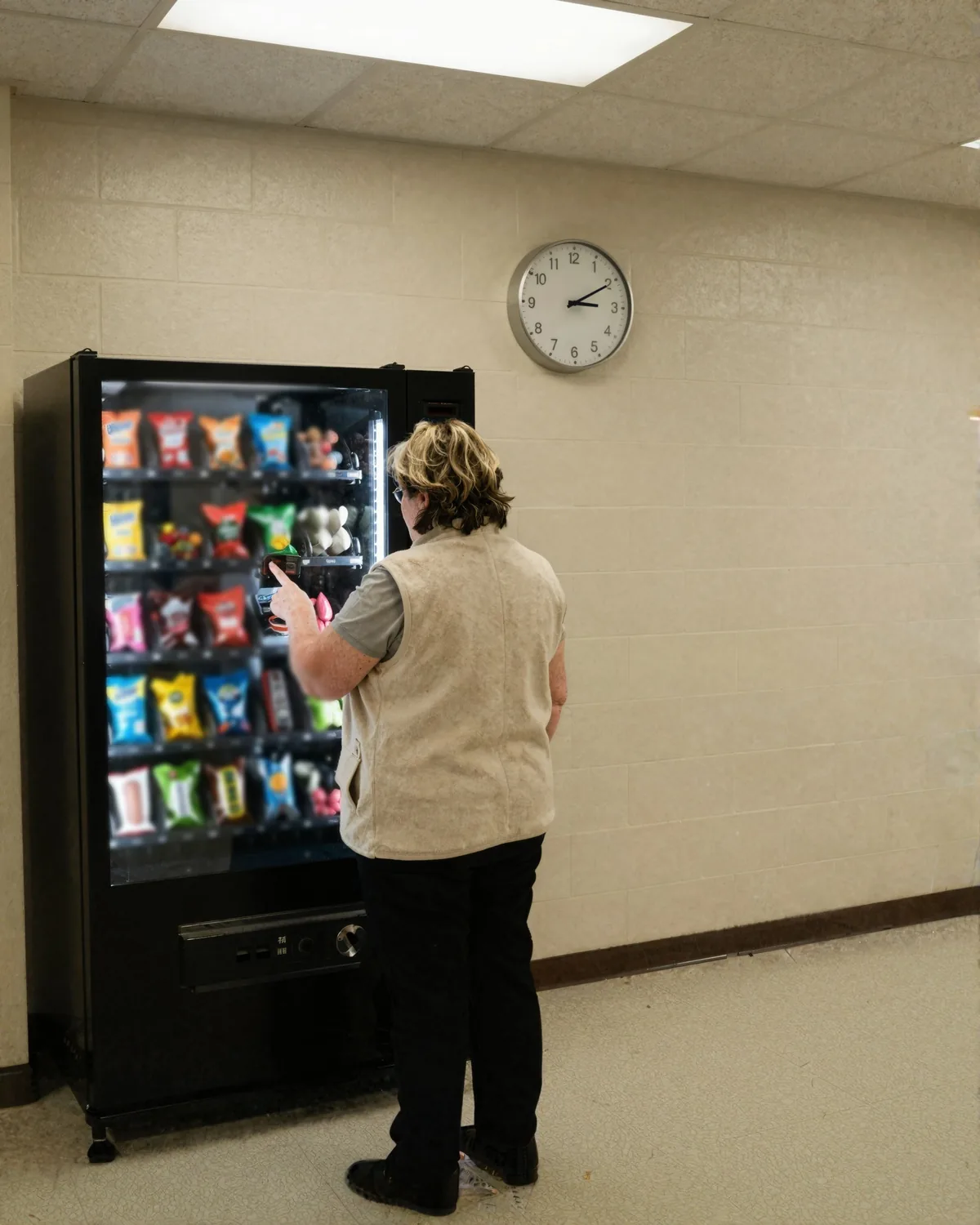
At 3:09 p.m. Renee Kowalski was standing in front of slot B4 with seven quarters going warm in her fist, and the noise in her head was so loud she did not hear the radio on her hip.
"Dispatch, Route 17. Dispatch, you there?"
She heard it the third time. She keyed the radio, told the substitute driver where Route 17 turns, and the whole time her eyes stayed on the orange wrapper behind the glass. Peanut butter cups. $1.75. She could have found the slot with her eyes shut.
She was not hungry. She had eaten lunch at noon. Her stomach was fine.
Her head was not. The thought had started around 1:30, the way it always did, quiet at first, then louder every half hour, like a radio someone kept turning up in the next room. By 3:10 she was no longer deciding anything. She was just walking down the hall.
She fed the first quarter into the machine. That was when Tasha walked in.
5:52 a.m.The glass booth at the edge of the lot
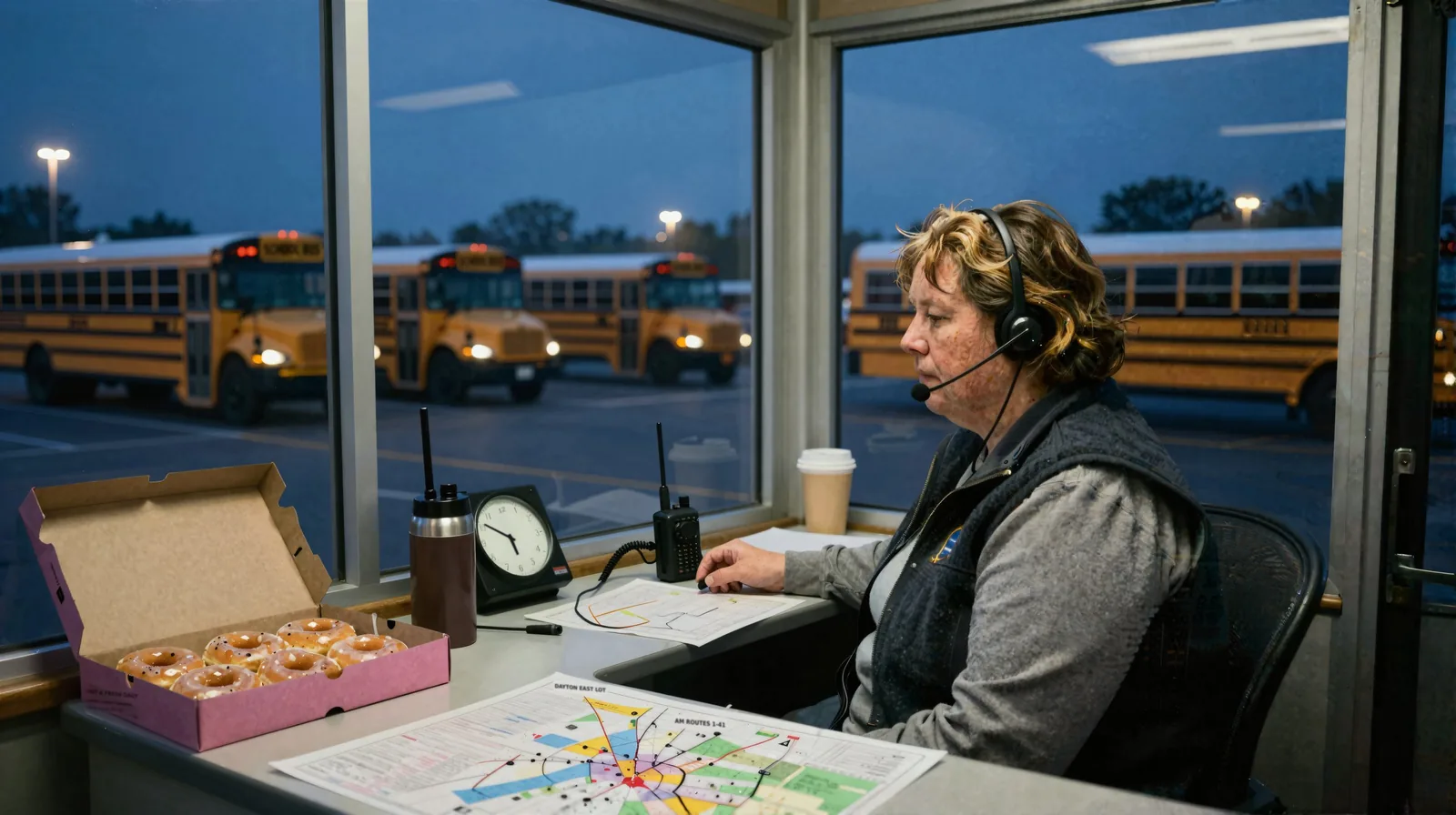
Renee is 47. Since 5:30 every school morning she sits in a glass booth at the edge of a bus lot on the east side of Dayton, a headset over her left ear and a laminated route map taped to the desk. Forty-one buses. Drivers out sick. Substitutes who do not know the turns.
On Tuesdays there is a pink box on the counter by the time clock. The night mechanic brings it in. Renee has eaten oatmeal at home and does not want a donut, and she thinks about the box from the moment she sees it until the box is empty.
Just half of one. You were up at four. Nobody counts on a Tuesday.
She kept a tally of her vending machine trips on a sticky note in her desk drawer, hoping the marks would shame her into stopping. The marks only got longer. She assumed everybody had a radio like hers. She assumed thin people simply had better self-control.
In September a letter arrived that made her question both of those things.
SeptemberThe letter on the fridge
Her doctor had brought up a GLP-1 medicine at her checkup in August. Renee said yes before he finished the sentence.
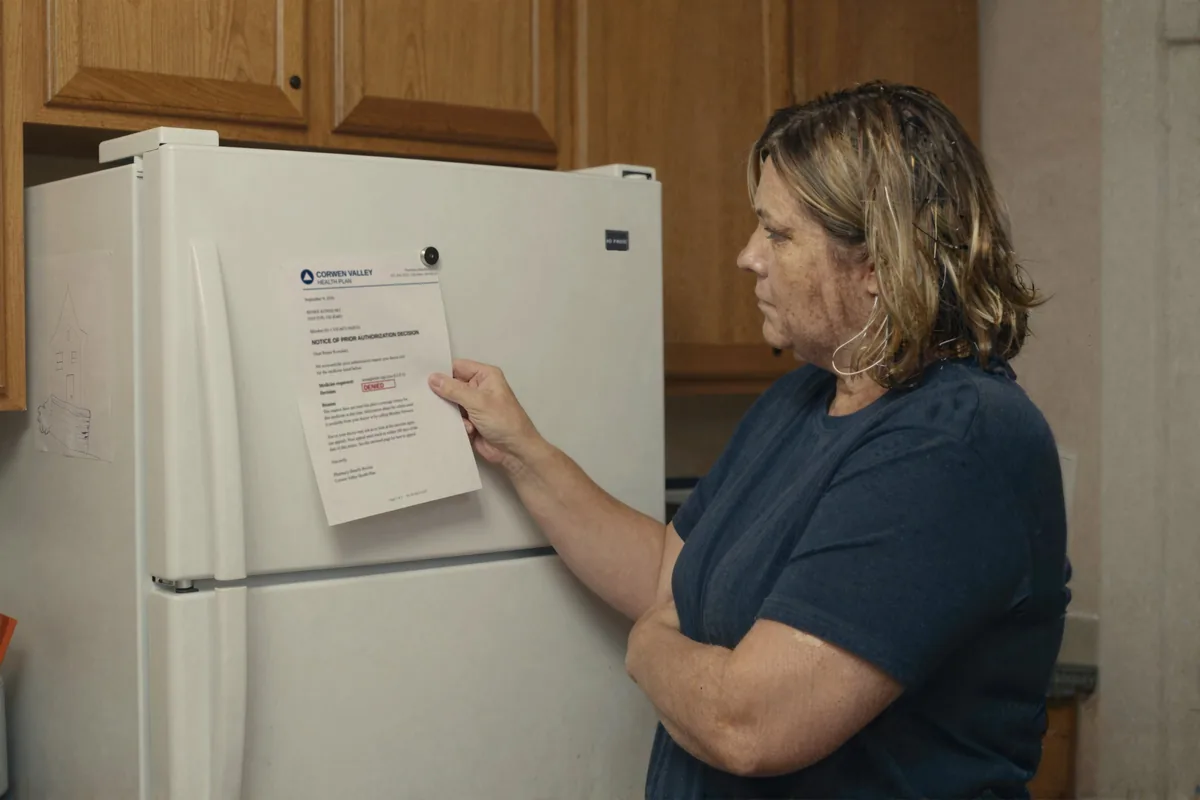
Three weeks later the insurance company answered. Prior authorization: denied. She read it in the minivan in the school pickup loop, then read it again, then took it home and stuck it to the fridge with a magnet shaped like Ohio, because she did not know what else to do with it.
She is far from alone. Researchers at ObesityWeek 2026 reported that more than a third of initial prior authorization requests for GLP-1 based therapies were denied, in a large group of commercially insured adults who met the clinical criteria.
Sources: AJMC on ObesityWeek 2026; Pennington Biomedical Research Center (ECO 2026); Google Keyword Planner, US, average Nov. 2025 to Oct. 2026.
The letter stayed on the fridge through September. Every evening Renee saw it when she got the milk out. Every afternoon at 3:10 she walked down the hall.
Then, on the last Tuesday of the month, a co-worker gave the radio a name.
3:10 p.m.Two words by the vending machine
Tasha drives Route 9. She had started a prescription GLP-1 in the spring. She stood in the doorway and watched Renee feed a second quarter into the machine.
"I used to do that every day," Tasha said. "It wasn't the candy. It was the noise. You know? The noise just stopped."
Renee's hand stopped with the third quarter at the slot.
Tasha described it from the inside: the thought that starts after lunch, the bargaining, the way it gets louder until walking down the hall feels like the only way to make it quiet. Renee had never heard anyone say it out loud. She had thought it was only hers.
It wasn't the candy. It was the noise. The noise just stopped.
Tasha, a school bus driver in Dayton
She put the quarters back in her pocket that afternoon. She did not buy anything. She also did not stop thinking about B4 until she clocked out at 4:30.
That night at the kitchen table, under the denial letter, she typed two words into her phone: food noise.
What she found was not a fad. It was a research question, and it explained why every diet she had tried had ended the same way.
The scienceWhat is food noise?
Food noise is the informal name for persistent, intrusive thoughts about food: thinking about lunch during breakfast, bargaining with yourself about a treat, feeling pulled toward food you do not physically need.
It is not a diagnosis, and for a long time it had no scientific definition. In 2023 researchers at Penn State proposed one. Their paper in the journal Nutrients described food noise as a form of heightened and persistent food cue reactivity, the way some people respond more strongly to the sight, smell or thought of food. They mapped it as a chain.
A cue, the things that make you more or less sensitive to it, your reaction, and the outcome.
- CueThe pink box by the time clock. The vending machine at 3:10.
- ModifiersSleep, stress, a skipped lunch, the habit of a daily treat.
- ReactionThoughts, bargaining, images of one specific food.
- OutcomeEating, or a long afternoon of saying no.
Source: Hayashi et al., What Is Food Noise? A Conceptual Model of Food Cue Reactivity, Nutrients 2023. Examples from Renee's day.
Renee read that chain three times. The first link was the one that stopped her: the cue. The pink box was a cue. The machine was a cue. So was 3:10 itself, the minute the last bus left the lot and the booth went quiet.
She pulled the sticky note out of the drawer that night and counted the marks. Most of them were on weekdays, almost none in the summer, when school was out and there was no booth and no hallway.
The noise was not following her. It was waiting for her, in one place, at one time.
The numbersWhy GLP-1 medicines quiet food noise
GLP-1 (glucagon-like peptide-1) is a hormone your own gut releases after a meal. It helps control blood sugar, slows how quickly the stomach empties and sends fullness signals to appetite centers in the brain. Prescription drugs such as semaglutide (Ozempic, Wegovy) and tirzepatide (Mounjaro, Zepbound) mimic it and last far longer than the natural hormone.
That brain effect is why so many users, Tasha among them, describe the noise turning down. In May 2026 a team from Pennington Biomedical Research Center presented a study at the European Congress on Obesity that put numbers on it. They followed 417 adults in a digital weight program for one month and measured food noise with the five-question Food Noise Questionnaire.
Lower is quieter. Both groups improved; the GLP-1 group moved further.
Source: Pennington Biomedical Research Center, Changes in Food Noise in Two Weight Management Programs, ECO 2026. Food Noise Questionnaire, 0 (none) to 20. One-month study funded by WeightWatchers.
Two details matter. The study ran for one month and was funded by WeightWatchers, which ran the programs. And the behavioral-only group improved too: the noise can move without a shot, just more slowly.
For a woman with a denial letter on her fridge, that second detail was the only one that mattered.
The question was how. The answer turned out to be the hallway.
OctoberThe plan on the back of a route sheet
Renee wrote it on the back of a route sheet, because that was the paper on her desk. Four lines.
Find the loudest hour. For her it was 3:10, every school day, the same machine.
Take away the cue. She asked the night mechanic to leave the Tuesday box in the break room instead of by the time clock. He shrugged and said sure. She started walking the long way to the restroom, past the loading dock instead of past B4.
Eat a real breakfast and lunch. Eggs or Greek yogurt in the morning, and a lunch with protein in it instead of whatever was left in the fridge.
Plan a replacement, not a refusal. This was the line that nearly beat her. Saying no to the same pull ten times an afternoon was exhausting. She needed something to look forward to at 3:10 that was not a candy bar: sweet, quick, small enough for a desk drawer, ready in seconds, because at 3:10 the phones do not stop.
The first three lines were easy. For two weeks the fourth one failed. Tea was not a reward. Sparkling water was not a reward. On the second Friday she walked down the hall, put seven quarters in the machine and ate the peanut butter cups in the booth with the door shut.
Then, the next week, she found a strawberry drink mix that came in single sticks: one stick, a glass of cold water, a sweet taste without the sugar. She kept the sticks in the drawer next to the sticky note.
The first Tuesday in October was the test.
3:10 p.m.The first Tuesday in October
The last bus rolled out at 3:08. The booth went quiet. At 3:10, out of habit, Renee stood up and walked down the hall.
She stopped in front of B4. The orange wrapper was behind the glass where it always was. The noise was there too. It had not gone anywhere.
But this time there was a glass of something pink already in her hand.
She stood there for a second. Then she walked back to the booth, picked up the headset and took a call from the driver on Route 17, who was lost again.
The noise had not gone anywhere. But this time there was a glass of something pink already in her hand.
Renee did not stop thinking about food. Nobody does. The letter is still on the fridge, and she has asked her doctor about appealing it. But the sticky note in the drawer has not gotten any longer since that Tuesday, and on most afternoons now the radio in the next room is turned down low enough that she can hear the one on her hip.
Food noise meaning vs. hunger
Hunger builds slowly, is satisfied by almost any food and goes away after you eat. The noise tends to fix on one specific thing, can arrive right after a meal and does not go away when you are full. If you have ever finished dinner and then thought about dessert for an hour, you know the difference.
| Physical hunger | Food noise | |
|---|---|---|
| How it starts | Gradually, hours after a meal | Suddenly, often triggered by a cue |
| What you want | Almost any food | One specific food, often sweet or salty |
| After eating | Goes away | Often returns, sometimes with guilt |
| Where you feel it | Stomach: growling, emptiness | Head: thoughts, bargaining, images |
Based on the cue-reactivity model in Hayashi et al., Nutrients 2023.
How to stop food noise without a shot
No one can promise silence. What works is turning the volume down at the moments it is loudest. These steps line up with the research on food cues and with what dietitians recommend:
- Find your loudest hour. Write down the time, the place and what you were doing for one week. Most people find two or three repeat moments.
- Remove the cue you see every day. Put the candy jar in a cupboard, take a different hallway, move the box. Every cue you never see is an argument you never have.
- Eat a real breakfast and lunch. Long gaps make the afternoon louder. Meals built around protein and fiber keep you fuller for longer; our GLP-1 diet guide lists foods that support your own GLP-1 release.
- Plan a replacement, not a refusal. Keep the time and the ritual, change what is in your hand: cheap, quick, low in sugar and genuinely enjoyable.
- Sleep. Short nights make cravings louder for many people.
Food noise and sugar cravings
For most people the loudest noise is sweet. Sugar cravings in the afternoon and at night are partly learned: a reward at the same time every day trains the brain to expect it then. A learned habit can be retrained, which is why the replacement step matters so much. Searches suggest a lot of Americans are fighting the same afternoon: US searches for "severe sugar craving" more than doubled in a year.
From 390 a month last winter to 880 in October 2026.
Source: Google Keyword Planner, US, English, November 2025 to October 2026, pulled Nov. 28, 2026.
Source: Google Keyword Planner, US, English, November 2025 to October 2026, pulled Nov. 28, 2026.
If you have read about berberine as a natural GLP-1 helper, our guide to natural GLP-1 supplements explains what the studies show and what they do not. If you are weighing a prescription instead, our guide to the GLP-1 pill and its self-pay price is the place to start.
Food noise: questions people ask
What is food noise?
Food noise is the everyday name for constant, intrusive thoughts about food: planning the next snack while you are still eating, or a pull toward a treat that keeps coming back however often you say no. It is not a medical diagnosis. Researchers at Penn State described it in 2023 as heightened, persistent food cue reactivity.
What does food noise mean on Ozempic or Wegovy?
People on semaglutide or tirzepatide often say the medicine made the food noise go quiet. GLP-1 acts on appetite areas of the brain and slows the stomach, so many users think about food less. A 2026 study of 417 adults found food noise scores fell further in people who started a GLP-1 drug than in a behavioral program alone.
How do you stop food noise without medication?
There is no switch, but you can turn it down: eat a real breakfast with protein, do not skip meals, sleep enough, remove the cues you see every day (the candy jar, the break-room box), and plan a replacement for the moment the pull is strongest. In the same 2026 study, behavioral treatment alone also lowered food noise, just less.
Is food noise real or just a lack of willpower?
It is real in the sense that people with strong food cue reactivity experience more frequent and more intense food thoughts, and those thoughts can be measured with a questionnaire. Treating it as a willpower failure tends to backfire, because the thoughts do not get tired the way you do.
Is there a food noise test?
Researchers use the Food Noise Questionnaire: five items, each scored 0 to 4, for a total of 0 to 20. It is a research tool, not a diagnosis. If food thoughts are taking over your day, a doctor or registered dietitian is the right person to talk to.
Does food noise come back after stopping a GLP-1?
It can. Many people report that hunger and food thoughts return when the medicine stops, which is one reason doctors plan the step down carefully. Do not stop a prescription on your own; talk to the clinician who prescribed it.
Is there a food noise supplement?
No supplement is approved to treat food noise, and none is a GLP-1 medicine. Some people use a low-calorie drink or snack as a planned replacement for the moment the pull is strongest, which is the approach behavioral programs teach. If you take any medicine, check a new supplement with your doctor first.
Sources and notes
- What Is Food Noise? A Conceptual Model of Food Cue Reactivity, Hayashi et al., Nutrients 2023 (PMC10674813)
- Changes in Food Noise in Two Weight Management Programs (ECO 2026), Pennington Biomedical Research Center, May 12, 2026
- ObesityWeek 2026: Studies Map GLP-1 Access Gaps, Obesity's Costs, AJMC, November 2026
- Glucagon-like peptide 1 (GLP-1), Molecular Metabolism 2019 (PMC6812410)
- Google Keyword Planner, United States, English: monthly search volume November 2025 to October 2026, pulled November 28, 2026
Search volumes are Google Keyword Planner monthly estimates for the United States, which Google rounds into bands; they show direction and scale, not exact counts.